Shirin Ebadi - Biography.
 I was born in the city of Hamadan [northwestern Iran] in 1947. My family were academics and practising Muslims. At the time of my birth my father was the head of Hamedan's Registry Office. My father, Mohammad Ali Ebadi, one of the first lecturers in commercial law, had written several books. He passed away in 1993.
I spent my childhood in a family filled with kindness and affection. I have two sisters and a brother all of whom are highly educated. My mother dedicated all her time and devotion to our upbringing.
Born: June 21, 1947 (age 70), Hamadan, Iran
Spouse: Javad Tavassolian (m. 1975)
Education: University of Tehran
Residence: London, England
Children: Nargess Tavassolian, Negar Tavassolian
Awards: Nobel Peace Prize, Glamour Award for The Peacemaker
I came to Tehran with my family when I was a one year old and have since been a resident in the capital. I began my education at Firuzkuhi primary school and went on to Anoshiravn Dadgar and Reza Shah Kabir secondary schools for my higher education. I sat the Tehran University entrance exams and gained a place at the Faculty of Law in 1965. I received my law degree in three-and-a-half years, and immediately sat the entrance exams for the Department of Justice. After a six-month apprenticeship in adjudication, I began to serve officially as a judge in March 1969. While serving as a judge, I continued my education and obtained a doctorate with honours in private law from Tehran University in 1971.
I held a variety of positions in the Justice Department. In 1975, I became the President of Bench 24 of the [Tehran] City Court. I am the first woman in the history of Iranian justice to have served as a judge. Following the victory of the Islamic Revolution in February 1979, since the belief was that Islam forbids women to serve as judges, I and other female judges were dismissed from our posts and given clerical duties. They made me a clerk in the very court I once presided over. We all protested. As a result, they promoted all former female judges, including myself, to the position of "experts" in the Justice Department. I could not tolerate the situation any longer, and so put in a request for early retirement. My request was accepted.
 Since the Bar Association had remained closed for some time since the revolution and was being managed by the Judiciary, my application for practising law was turned down. I was, in effect, housebound for many years. Finally, in 1992 I succeeded in obtaining a lawyer's licence and set up my own practice.
I used my time of unemployment to write several books and had many articles published in Iranian journals. After receiving my lawyer's licence I accepted to defend many cases. Some were national cases. Among them, I represented the families of the serial murders victims (the family of Dariush and Parvaneh Foruhar) and Ezzat Ebrahiminejad, who were killed during the attack on the university dormitory. I also participated in some press-related cases. I took on a large number of social cases, too, including child abuse. Recently I agreed to represent the mother of Mrs Zahra Kazemi, a photojournalist killed in Iran.
I also teach at university. Each year, a number of students from outside Iran join my human rights training courses.
I am married. My husband is an electrical engineer. We have two daughters. One is 23 years old. She is studying for a doctorate in telecommunications at McGill University in Canada. The other is 20 years old and is in her third year at Tehran University where she reads law.
Social Activities
– Leading several research projects for the UNICEF office in Tehran.
– Cofounder of the Association for Support of Children's Rights, 1995. I was the association's president until 2000, and have continued to assist them as legal adviser. Currently the association has over 500 active members.
– Providing various stages of free tuition in children's rights and human rights.
– Cofounder of the Human Rights Defence Centre with four defence lawyers, 2001. I am the centre's president.
– Delivering over 30 lectures to university and academic conferences and seminars on human rights. The lectures have been delivered in Iran, France, Belgium, Sweden, Switzerland, Britain and America.
– Representing several journalists or their families, accused or sentenced in relation to freedom of expression. They include Habibollah Peyman (for writing articles and delivering speeches on freedom of expression); Abbas Marufi, the editor-in-chief of the monthly Gardoun (for publishing several interviews and poems); Faraj Sarkuhi (editor-in-chief of Adineh monthly).
– Representing families of serial murder victims (the Foruhar family).
– Representing the family of Ezzat Ebrahiminejad, murdered in the 9 July 1999 attack on the university dormitory.
– Representing the mother of Arin Golshani, a child separated from her mother as a consequence of the child custody law. She was found tortured to death at the home of her stepmother.
– Proposing to the Islamic Consultative Assembly (Majlis) to ratify a law on prohibiting all forms of violence against children; as a result the law was promptly debated and ratified in the summer of 2002.
 Publications
Books
– Criminal Laws, Tehran 1972. Published by Bank Melli of Iran (Professor Rahnama; Professor Abdolhoseyn Aliabadi).
– The Rights of the Child; A study in the legal aspects of children's rights in Iran, 1987. Translated into English by Mohammad Zamiran. Published by UNICEF, 1993.
– Medical Laws; Tehran, 1988. Published by Zavar.
– Young Workers, Tehran, 1989. Published by Roshangaran.
– Copyright Laws, Tehran, 1989. Published by Roshangaran.
– Architectural Laws, Tehran, 1991. Published by Roshangaran.
– The Rights of Refugees, Tehran, 1993. Published by Ganj-e Danesh.
– History and Documentation of Human Rights in Iran, Tehran, 1993. Published by Roshangaran.
– Tradition and Modernity, Tehran 1995. Written by Mohammad Zamiran, Shirin Ebadi. Published by Ganj-e Danesh.
– Children's Comparative Law, Tehran, 1997. Published by Kanoun (This book was translated into English by Mr Hamid Marashi, and published by UNICEF in Tehran in 1998).
– The Rights of Women, Tehran, 2002. Published by Ganj-e Danesh.
* Details provided are taken from the original publications.
Articles
– "The Child and Family Law"; A series of articles appearing in the Encyclopedia Iranica. Published by Columbia University.
– "The Rights of Parents"; Article published in the journal Studies in the Social Impacts of Biotechnology. Published by CNRS, France
– "Women and Legal Forms of Violence in Iran"; Article published in the Bonyad Iran journal in Paris on the subject of violence.
– Over 70 articles on various aspects of human rights which have appeared in various publications in Iran. Some have been translated into English. They were presented at CRC [Convention on the Rights of the Child], a seminar organized by UNICEF in 1997.
– Articles published in various weeklies, including Fekr-e Now New Ideas, on various aspects of laws relating to women.
Publications
Books
– Criminal Laws, Tehran 1972. Published by Bank Melli of Iran (Professor Rahnama; Professor Abdolhoseyn Aliabadi).
– The Rights of the Child; A study in the legal aspects of children's rights in Iran, 1987. Translated into English by Mohammad Zamiran. Published by UNICEF, 1993.
– Medical Laws; Tehran, 1988. Published by Zavar.
– Young Workers, Tehran, 1989. Published by Roshangaran.
– Copyright Laws, Tehran, 1989. Published by Roshangaran.
– Architectural Laws, Tehran, 1991. Published by Roshangaran.
– The Rights of Refugees, Tehran, 1993. Published by Ganj-e Danesh.
– History and Documentation of Human Rights in Iran, Tehran, 1993. Published by Roshangaran.
– Tradition and Modernity, Tehran 1995. Written by Mohammad Zamiran, Shirin Ebadi. Published by Ganj-e Danesh.
– Children's Comparative Law, Tehran, 1997. Published by Kanoun (This book was translated into English by Mr Hamid Marashi, and published by UNICEF in Tehran in 1998).
– The Rights of Women, Tehran, 2002. Published by Ganj-e Danesh.
* Details provided are taken from the original publications.
Articles
– "The Child and Family Law"; A series of articles appearing in the Encyclopedia Iranica. Published by Columbia University.
– "The Rights of Parents"; Article published in the journal Studies in the Social Impacts of Biotechnology. Published by CNRS, France
– "Women and Legal Forms of Violence in Iran"; Article published in the Bonyad Iran journal in Paris on the subject of violence.
– Over 70 articles on various aspects of human rights which have appeared in various publications in Iran. Some have been translated into English. They were presented at CRC [Convention on the Rights of the Child], a seminar organized by UNICEF in 1997.
– Articles published in various weeklies, including Fekr-e Now New Ideas, on various aspects of laws relating to women.
 Prizes and Accolades
1. An official Human Rights Watch observer, 1996.
2. The selection of The Rights of the Child as Book of the Year by the Culture and Islamic Guidance Ministry.
3. Recipient of the Rafto Human Rights Foundation prize for human rights activities, Norway 2001.
4.
The Nobel Peace Prize, Norway 2003.
Prizes and Accolades
1. An official Human Rights Watch observer, 1996.
2. The selection of The Rights of the Child as Book of the Year by the Culture and Islamic Guidance Ministry.
3. Recipient of the Rafto Human Rights Foundation prize for human rights activities, Norway 2001.
4.
The Nobel Peace Prize, Norway 2003.
Benazir Bhutto Biography

Benazir Bhutto became prime minister of Pakistan in 1988. She was the first woman in modern times to head the government of an Islamic state, and she followed her father, Zulfikar Ali Bhutto, who served as prime minister from 1971 to 1977.
Benazir Bhutto Biography
Birth Date:21st June, 1953
Died At Age: 54
Sun Sign:Gemini Gemini Women
Born In:Karachi
Father:Zulfiqar Ali Bhutto
Mother:Nusrat Bhutto
Siblings:Murtaza Bhutto, Shahnawaz Bhutto, Sanam Bhutto
Spouse/Partner:Asif Ali Zardari (1987–2007)
Children:Bilawal Bhutto Zardari, Bakhtawar Bhutto Zardari, Bakhtwar Bhutto, Aseefa Bhutto
Religion:Islam
Died On:December 27th, 2007
Place Of Death:Rawalpindi
Cause Of Death:Assassination
More Facts
Also Listed In:Political Leaders, Prime Ministers
Nationality:Pakistani Famous Pakistani Women
Political Ideology:Pakistan Peoples Party
Education: Lady Margaret Hall Oxford (1973 – 1977), St Catherine's College Oxford (1976 – 1977), Radcliffe College (1969 – 1973), Karachi Grammar School, University of Oxford, Harvard University
Popularly known as the Iron Lady of Pakistan, Benazir Bhutto opened the doors of politics for women in Pakistan. Not only did she become the first woman to head a major political party, but she went on to become the first and till date, the only female Prime Minister of Pakistan. She served this powerful position twice in her lifetime. Born in a prominent political family, she was exposed to political thoughts and beliefs since a young age.
The imprisonment and the subsequent execution of her father, Zulfikar Ali Bhutto, brought Benazir into the centre stage of Pakistan politics as she succeeded her father as the titular head of the Pakistan People’s Party. Most of her ideals were centred on democratic and social capitalist policies. Her charismatic presence coupled with political shrewdness and unabated courage earned her the nickname ‘Iron Lady’. Most of her contemporaries and rivals respectfully addressed her as ‘B.B’. During her term as the Prime Minister from 1988 until 1990 and 1993 until 1996, she brought about several political and economic policies for industrial development and growth. She favoured denationalisation of state-owned corporations and took a hard stand against trade unions and rigid labour markets. However, high levels of corruption, escalating unemployment and stifling recession brought about an end to her governance. To know more about her life and profile, scroll further.
Childhood & Early Life
Benazir Bhutto was born to Zulfikar Ali Bhutto and Begum Nusrat Ispahani. She was the eldest of the four siblings. Her father was the former prime minister of Pakistan. As such, since young, she was exposed to political ideas and policies.
She completed her early education from Pakistan and went to US to enrol herself at Radcliffe College, Harvard University. In 1973, she graduated with a Bachelor of Arts degree with cum laude honours in comparative government.
From 1973 until 1977, she studied philosophy, politics and economics at Lady Margaret Hall, Oxford, United Kingdom.
In 1976, she became the first Asian woman to be elected as the President of Oxford Union.
Political Career
Upon her return to Pakistan in 1977, she along with her family was placed under house arrest following the dethronement of her father Zulfikar Ali Bhutto from the prime ministership and the emergence of General Mohammad Zia ul-Haq to power.
She inherited the leadership of her father’s political party, Pakistan People’s Party (PPP) and spent the next two years organizing rally to force General Haq to drop murder charges against her father.
Against local plea and international pressure, Zulfikar Ali Bhutto was hanged on April 1979, following which she was arrested and moved to Larkana Central Jail. In 1981, she was imprisoned in a desert cell in Sindh Province.
Succumbing to immense international pressure, she along with her family was allowed to travel abroad in 1984 for medical aid. Following her recuperation, she resumed her political pursuit, becoming a leader in exile for PPP, raising awareness of the state of political prisoners and human right violation under Zia regime.
In 1986, she returned to Pakistan after two years of self-exile upon the lifting of the martial law and launched a nationwide campaign for open elections.
In 1988, a mysterious air accident caused the death of General Haq, leaving a vacuum in Pakistan politics and the need for elections.
In the 1988 elections, the PPP party led by her emerged as the winner, winning the largest percentile of seats in the National Assembly. She was designated to the prime ministerial position on December 2, 1988, thus becoming the first woman prime minister of a Muslim state.
During her first term as prime minister, she could not do much to combat the problems of poverty, corruption and crime. Moreover, her aim to shift Pakistan's semi-presidential system to a parliamentary system also turned out to be a failure as most of the proposed laws were vetoed by conservative President Ghulam Ishaq Khan.
In 1990, following the failure to curb corruption and unemployment and the downfall in the economic graph of the country, President Khan ousted her from the Prime Minister position using the Eight Amendment with charges of corruption, nepotism and despotism.
In the 1990 elections that occurred at the aftermath of her expulsion, her party failed to register a victory and opposition leader Nawaz Shariff succeeded the chair. She accepted her defeat and took over the role of the Leader of Opposition.
Following the resignation of Nawaz Sharif and President Khan in 1993, elections were held and PPP party won the same. She was elected for a second term as the Prime Minister of Pakistan. She appointed Farooq Leghari as the President.
During election campaign Benazir promised promised price supports for agriculture, pledged a partnership between government and business and campaigned strongly for the female vote. However, once in power, she was not able to implement any of her agendas and failed miserably.
She was neither able to contain racial tension that was at its peak in Karachi nor corruption scandals which only worsened the economic condition of the country. Furthermore, women issues were not dealt with as no reforms were made and controversial laws were instead exercised more toughly.
 She had promised denationalization programme and liberalisation of the economy during her second term but none of the same ever occurred. As such, inflation and unemployment increased thus causing a decline in the living standard of the people.
With the ever increasing corruption and death of younger brother, the credibility of her government declined. It faced harsh criticism became hugely unpopular amongst the public, a result of which was dismissal of her government in 1996.
In 1997, she moved to Dubai along with her children to escape the corruption charges by the Nawaz Sharif government. Her husband, Asif Ali Zardari was held in captive and imprisoned.
She had promised denationalization programme and liberalisation of the economy during her second term but none of the same ever occurred. As such, inflation and unemployment increased thus causing a decline in the living standard of the people.
With the ever increasing corruption and death of younger brother, the credibility of her government declined. It faced harsh criticism became hugely unpopular amongst the public, a result of which was dismissal of her government in 1996.
In 1997, she moved to Dubai along with her children to escape the corruption charges by the Nawaz Sharif government. Her husband, Asif Ali Zardari was held in captive and imprisoned.
From 1996 until 1999, she became the Leader of the Opposition in exile in the Parliament. In 1999, Pakistan’s involvement in Kargil War brought about international shame for the country and hindered Shari’s public image. Benazir capitalized on the situation and gathered support for herself.
She aimed to bring her PPP party back in action but when Pakistan Armed forces adopted the coup d'état, she supported the same. With General Pervez Musharraf’s ascend to power, her demand for corruption charges being dropped were denied. As a result, she remained in exile in London and Dubai.
In 2002, when Pervez Musharraf amended the Pakistan constitution, banning prime ministers from serving more than two terms, her chance to hold office ever again was disrupted. Furthermore, prohibition for a court-convicted individual from holding party office made it impossible for her to compete in the elections.
In 2007, she returned after serving eight years of self-imposed exile. All charges against her were pardoned by Musharraf and a power-sharing deal between Bhutto and Musharraf’s military regime came into force.
Upon her return, she participated in the preparation for 2008 parliamentary elections. However, the same was cut short due to her assassination in December 2007.
Awards & Achievements
Posthumously, she was named one of seven winners of the United Nations Prize in the Field of Human Rights.
Personal Life & Legacy
She married Asif Ali Zardari on December 18, 1987. The couple was blessed with two daughters and a son.
Following her return to Pakistan, while campaigning for the parliamentary elections, she was assassinated on December 27, 2007. She was leaving for the campaign rally for PPP at Liaquat National Bagh, when she was shot by a gunman while she waved the crowd through the sunroof of her car. Subsequently, explosives were detonated near the vehicle killing approximately 20 people
She was taken to Rawalpindi General Hospital where she was declared dead by evening. A three-day period of mourning was declared by President Pervez Musharraf.
In order to pay gratitude and respect to the contributions she made in the political scenario of the country, the government of Pakistan renamed Islamabad International Airport as Benazir Bhutto International Airport, Muree Road of Rawalpindi as Benazir Bhutto Road and Rawalpindi General Hospital as Benazir Bhutto Hospital.
Trivia
She was the first female Prime Minister of Pakistan and the first woman to head a major political party in a Muslim state.
Mahatma Gandhi
 Mahatma Gandhi was born as Mohandas Karamchand Gandhi on 2nd October 1869. He was the most popular as well as the most influential political and spiritual leaders of India.
His contribution to the freedom struggle of India is priceless and the country owes its independence, partly, to this great man. The Satyagraha movement, which led to India's independence, was founded by Mahatma Gandhi only. In India, Gandhi is known as the 'Father of the Nation' and his birthday is celebrated as a national holiday. Read on to explore the life history, story and biography of Mohandas Karamchand Gandhi:
Full name: Mohandas Karamchand Gandhi
Birth date: October 2, 1869
Death date: January 30, 1948 (aged 78)
Birth place: Porbandar, British India
Education: University London
Occupation: Lawyer, Politician
Spouse (s): Kasturbai Makhanji Kapadia
Religion: Hinduism
Zodiac sign: Leo
Early Life
Mohandas Karamchand Gandhi was born in the Porbandar city of Gujarat, to Karamchand Gandhi, the diwan of Porbandar, and his wife, Putlibai. Since his mother was a Hindu of the Pranami Vaishnava order, Gandhi learned the tenets of non-injury to living beings, vegetarianism, fasting, mutual tolerance, etc, at a very tender age. Mohandas was married at the age of 13 to Kasturba Makhanji and had four sons. He passed the matriculation exam at Samaldas College of Bhavanagar. In the year 1888, Gandhi went to University College of London to study as a barrister.
He came back to India after being called to the bar of England and Wales by Inner Temple. In 1893, he accepted a yearlong contract from an Indian firm to a post in Natal, South Africa. There, he faced racial discrimination directed at blacks and Indians. Such incidents provoked him to work towards social activism.
Participation in Indian Independence Movement
Gopal Krishna Gokhale, a leader of the Congress Party, introduced Mahatma Gandhi to the Indian issues, Indian politics and the Indian people. Gandhi participated in the following movements related to India's freedom struggle:
Champaran and Kheda Satyagraha
The Champaran Agitation and Kheda Satyagraha of 1918 was the first major success of Mahatma Gandhi in his struggle towards India's freedom. The reason for the agitation was the levy of an oppressive tax by the British, which they insisted on increasing further. He organized his supporters as well as volunteers to protest against this atrocity and also began leading the clean up of villages, building of schools and hospitals as well as encouraging the village leadership to condemn the numerous social evils affecting the society. Mahatma Gandhi was successful in signing an agreement with the British, wherein the poor farmers were granted more compensation and control over farming.
 Non-cooperation Movement and Swaraj
Non-cooperation Movement of Mahatma Gandhi was one of his prime fights against the British. The massacre at the Jallianwala Bagh of Punjab was what instigated him to take this step. After the gruesome incident, he focused himself entirely on obtaining complete autonomy for the country as well as the control of all Indian government institutions. Soon, this movement turned into Swaraj (complete individual, spiritual and political independence). His association with the Indian National Congress (INC) was further strengthened in December 1921, when he was made the executive authority of the party.
Non-cooperation Movement and Swaraj
Non-cooperation Movement of Mahatma Gandhi was one of his prime fights against the British. The massacre at the Jallianwala Bagh of Punjab was what instigated him to take this step. After the gruesome incident, he focused himself entirely on obtaining complete autonomy for the country as well as the control of all Indian government institutions. Soon, this movement turned into Swaraj (complete individual, spiritual and political independence). His association with the Indian National Congress (INC) was further strengthened in December 1921, when he was made the executive authority of the party.
Under Mahatma Gandhi, INC was restructured, accepting the goal of Swaraj, having open membership, forming a hierarchy of committees, and so on. He urged Indian citizens to boycott imported goods, British educational institutions, law courts, government employment, and the like. Non-cooperation became very popular and started spreading through the length and breadth of India. However, the violent clash in Chauri Chaura town of Uttar Pradesh, in February 1922, led to a sudden end of this movement. Gandhi was arrested on 10th March 1922 and was tried for sedition. He was sentenced to six years imprisonment, but served for only two years in prison.
Problems in the Indian National Congress
Indian National Congress began to fall apart without the inspiring leadership of Mahatma Gandhi. The party split up into two groups, one led by Chitta Ranjan Das and Motilal Nehru and the other led by Chakravarti Rajagopalachari and Sardar Vallabhbhai Patel. Even the basis of the non-violence campaign, the cooperation amongst Hindus and Muslims, began to break down.
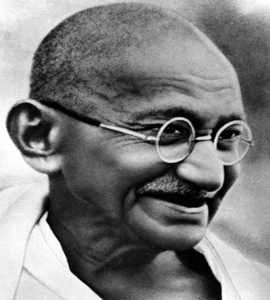 Salt Satyagraha and Dandi March
During the period of 1920s, Mahatma Gandhi concentrated on resolving the wedge between the Swaraj Party and the Indian National Congress. Around 1928, Gandhi again started focusing on Indian freedom struggle. In 1927, British had appointed Sir John Simon as the head of a new constitutional reform commission. There was not even a single Indian in the commission. Agitated by this, Gandhi passed a resolution at the Calcutta Congress in December 1928, calling on the British government to grant India dominion status. In case of non-compliance with this demand, the British were to face a new campaign of non-violence, having its goal as complete independence for the country. The resolution was rejected by the British.
Salt Satyagraha and Dandi March
During the period of 1920s, Mahatma Gandhi concentrated on resolving the wedge between the Swaraj Party and the Indian National Congress. Around 1928, Gandhi again started focusing on Indian freedom struggle. In 1927, British had appointed Sir John Simon as the head of a new constitutional reform commission. There was not even a single Indian in the commission. Agitated by this, Gandhi passed a resolution at the Calcutta Congress in December 1928, calling on the British government to grant India dominion status. In case of non-compliance with this demand, the British were to face a new campaign of non-violence, having its goal as complete independence for the country. The resolution was rejected by the British.
The flag of India was unfurled in Lahore by the members of the INC on 31st December 1929. January 26, 1930 was celebrated as the Independence Day of India. Soon, British government levied a tax on salt and Salt Satyagraha was launched in March 1930, as an opposition to this move. Mahatma Gandhi started the Dandi March with his followers in March, going from Ahmedabad to Dandi on foot, to make salt himself. The campaign became so successful that British ended up arresting over 60,000 people who participated in the March. Gandhi-Irwin Pact was signed in March 1931, where the British Government set all political prisoners free as an exchange for the suspension of the civil disobedience movement.
Quit India Movement
As the World War II progressed, Mahatma Gandhi intensified his protests for the complete independence of the Indian subcontinent. He drafted a resolution calling for the British to Quit India. The 'Quit India Movement' or the 'Bharat Chhodo Andolan' was the most aggressive revolt of the INC, with the aim of gaining complete exit of the British from India. Gandhi was arrested on 9th August 1942 and held for two years in the Aga Khan Palace in Pune. There, he lost his secretary, Mahadev Desai and his wife, Kasturba. The Quit India Movement came to an end by the end of 1943, when the British gave hints that complete power would be transferred to the people of India.
Freedom and Partition of India
The independence cum partition proposal offered by the British Cabinet Mission in 1946 was accepted by the Congress, inspite of being advised otherwise by Mahatma Gandhi. Sardar Patel convinced Gandhi that it was the only way to avoid civil war and he reluctantly gave his consent. After India's independence, Gandhi focused on peace and unity of Hindus and Muslims. He launched his last fast-unto-death in Delhi, asking for all communal violence to be stopped and the payment of Rs. 55 crores, as per the Partition Council agreement, to be made to Pakistan. Ultimately, all the political leaders conceded to his wishes and he broke his fast by sipping orange juice.
Assassination
The inspiring life of Mahatma Gandhi came to an end on 30th January 1948, when he was shot by Nathuram Godse. Nathuram was a Hindu radical, who held Gandhi responsible for weakening India by ensuring the partition payment to Pakistan. Godse and his co-conspirator, Narayan Apte, were later tried and convicted. They were executed on 15th November 1949.
Gandhi's Principles
Mahatma followed as well as preached the following principles throughout his life:
Truth
Nonviolence
Vegetarianism
Brahmacharya (Celibacy)
Simplicity
Faith in God
Bangabandhu Sheikh Mujibur Rahman:
 Bangabandhu Sheikh Mujibur Rahman(1920-1975) Father of the nation and first president of Bangladesh (26 March 1971 to 11 January 1972). Sheikh Mujibur Rahman was born on 17 March 1920 in the village Tungipara under Gopalganj subdivision in the district of Faridpur. His father Sheikh Lutfar Rahman was a serestadar in the civil court of Gopalganj. Mujib, the third among six brothers and sisters, had his primary education in the local Gimadanga School. His early education suffered for about four years due to eye problems. He passed his Matriculation from Gopalganj Missionary School in 1942, Intermediate of Arts from Calcutta Islamia College in 1944 and BA from the same college in 1947.
Full name: Bangabandhu Sheikh Mujibur Rahman
Birth date: March 17, 1920
Birthplace: Tungipara, Gopalganj, Bangladesh
Occupation: Politician
Assassinated: August 15, 1975 (aged 55)
Political party: Awami League
Spouse: Sheikh Fazilatunnesa Mujib
Children: Hasina, Rehana, Kamal, Jamal, Rasel
Religion: Islam
Zodiac sign: Pisces
Bangabandhu Sheikh Mujibur Rahman
Mujib showed the potential of leadership since his school life. While a student of Gopalganj Missionary School, AK Fazlul Huq, the then Chief Minister of Bengal, came to visit the school (1938). The young Mujib is said to have organized an agitation in order to impress the chief minister about the depressed situation of the region. While a student in Islamia College he was elected general secretary of the College Students Union in 1946. He was an activist of the Bengal Provincial Muslim League and a member of the All India Muslim League Council from 1943 onwards. In politics he had been a fervent follower of hs suhrawardy.
During the general elections of 1946, Sheikh Mujib was deputed by the Muslim League to work for the party candidates in the Faridpur district. After partition (1947), he got himself admitted into the University of Dhaka to study law but was unable to complete it, because he was expelled from the University in early 1949 on the charge of 'inciting the fourth-class employees' in their agitation against the University authority's indifference towards their legitimate demands.
Sheikh Mujibur Rahman was one of the principal organisers behind the formation of the East Pakistan Muslim Students League (1948). In fact, Sheikh Mujib's active political career began with his election to one of the three posts of joint secretaries of the newly established East Pakistan Awami Muslim League (1949) while interned in jail. The other two joint secretaries were Khondakar Mostaq Ahmad and AK Rafiqul Hussain. In 1953, Sheikh Mujib was elected general secretary of the East Pakistan Awami Muslim League, a post that he held until 1966 when he became president of the party. It was due to Mujib's initiative that in 1955 the word 'Muslim' was dropped from the name of the party to make it sound secular. It is indicative of his secularist attitude to politics that he developed after 1947.
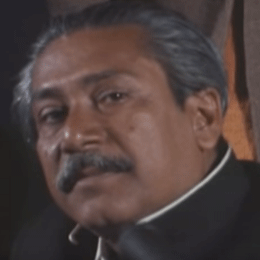 To give full time to the organizational affairs of the Awami League, Sheikh Mujibur Rahman resigned from the cabinet of ataur rahman khan (1956-58) after serving for only nine months. During the time of general Ayub Khan, Mujib had the nerve to revive the Awami League in 1964, though his political guru, Suhrawardy, was in favour of keeping political parties defunct and work under the political amalgam called National Democratic Front for the restoration of constitutional rule in Pakistan. Mujib, after all, was already quite disillusioned about the concept of Pakistan. The impression that he got as a member of Pakistan's Second Constituent Assembly-cum-Legislature (1955-1956) and later as a member of Pakistan National Assembly (1956-1958) was that the attitude of West Pakistani leaders to East Pakistan was not one of equality and fraternity.
Sheikh Mujib was one of the first among the language movement detainees (11 March 1948). His address on 21 September 1955 in the Pakistan Constituent Assembly on the question of Bangla language is noteworthy. Claiming the right to speak in his mother tongue, Sheikh Mujibur Rahman said:
'We want to speak in Bengali here, whether we know any other language or not it matters little for us. If we feel that we can express ourselves in Bengali we will speak always in Bengali even though we can speak in English also. If that is not allowed, we will leave the House, but Bengali should be allowed in this house; that is our stand.'
In another address (25 August 1955) what Sheikh Mujib said in the Constituent Assembly in protest against the change of nomenclature of the province from East Bengal to East Pakistan is equally pertinent.
' Sir, you will see that they want to place the word 'East Pakistan' instead of 'East Bengal'. We have demanded so many times that you should use [East] Bengal instead of [East] Pakistan. The word 'Bengal' has a history, has a tradition of its own....'
Sheikh Mujibur Rahman grew in political eminence in the early 1960s. Through his captivating organizing ability he was able to retrieve the Awami League from intra party politics and exits of a number of factions from the party's mainstream. A magnetic organiser, Sheikh Mujib had established his full command over the party.
In 1966, he announced his famous six-point programme what he called 'Our' [Bangalis'] Charter of Survival'. The points are: 1) a federal State and introduction of parliamentary form of government based on universal adult franchise; 2) all departments except defense and foreign affairs will be vested in the hands of the federating units or provincial governments; 3) separate currencies for two states or effective measures to stop flight of capital from East Pakistan to West Pakistan; 4) transfer of all rights of taxation to the states; 5) independence of the states in international trades; and finally 6) rights of the states to create' militia or para-military forces for self-defense.
In short, the programme envisioned a new approach to political life. In letters and spirit, the Six-Point Programme meant virtual independence for East Pakistan. Though conservative elements of all political parties looked at it with consternation, it roused the imagination of the younger generation right away, particularly the students, youth and working classes.
Following the presentation of the challenging Six-point programme by Mujib, the Ayub regime put him behind the bars. A sedition case, known as agartala conspiracy case officially named as State vs. Sheikh Mujibur Rahman and Others, was brought against him along with 34 others. Majority of them were Bangali officers and servicemen in Pakistan Air and Naval forces. They also included three senior Bangali civil servants.
As Mujib was already in prison he was shown arrested as number one accused. He was charged with conspiring against the state of Pakistan together with the other co-accused. According to the allegations, Sheikh Mujibur Rahman and the other accused were secretly planning to separate East Pakistan by force with the help of India. The counter-offensive move, however, proved to be counter-productive. The trial of the case in a special tribunal in the Dhaka Kurmitola Cantonment stirred up Bangali emotion and sentiment against Pakistani domineering attitude to East Pakistan.
During the trial in the Agartala Conspiracy Case, Mujib's charisma grew further and almost the whole nation stood up in protest of the trial of their leader. The mass movement, organized especially by the younger generation, reached such a momentum in early 1969 that the Ayub regime tried to avoid an impending civil war in the country by withdrawing the case. Sheikh Mujib was released on 22 February 1969 unconditionally.
On the following day of his release, the Sarbadaliya Chhatra Sangram Parishad (All Parties Students Action Committee) which proved to be the most effective political and social force in compelling the government to free Sheikh Mujib unconditionally, organised a mass reception to Sheikh Mujibur Rahman at ramna racecourse (now, Suhrawardy Udyan). On behalf of the Sangram Parishad Tofael Ahmed, the president of the Sangram Parishad, bestowed on Sheikh Mujibur Rahman the title of 'Bangabandhu' (Friend of the Bangalis). In him, they saw a kind of sacrificing leader who suffered jail terms for about twelve years during the 23 years of Pakistani rule. Twelve years in jail and ten years under close surveillance, Pakistan to Sheikh Mujib proved to be more a prison than a free homeland.
The first ever general elections of Pakistan in December 1970 made Bangabandhu Sheikh Mujibur Rahman the sole spokesman of East Pakistan. Under his leadership, the Awami League won 167 (including 7 women reserved seats) out of 169 seats allotted to East Pakistan in the Pakistan National Assembly. The people gave him the absolute mandate in favour of his Six-point doctrine. Now it was his turn to implement it. Bangabandhu Sheikh Mujibur Rahman at a solemn ceremony held on 3 January 1971 at Ramna Race Course with all the East Pakistan representatives took an oath never to deviate from the six-point when framing the Constitution for Pakistan.
Under the circumstances, General Yahya's military junta and Z.A Bhutto, the elected leader of West Pakistan, conspired not to allow Bangabandhu Sheikh Mujibur Rahman to form the government in the centre. On 1 March 1971, President Yahya Khan postponed unilaterally the Dhaka National Assembly meet scheduled to be held on 3 March. The announcement triggered off the general agitation in East Pakistan. In response, the Bangabandhu called for an all-out non-cooperation movement in East Pakistan. The whole province supported him. During the course of non-cooperation (2-25 March 1971), the entire civil administration in East Pakistan came under his control and moved according to his directives. He became, in fact, the de facto head of government for the province. In the words of Evening Standard (a London Daily):
'Sheikh Mujibur Rahman now appears to be the boss of East Pakistan, with the complete support of the population. Rahman's home in Dhanmondi, already known as Number 10 Downing Street in imitation of the British Prime Minister's residence, has been besieged by bureaucrats, politicians, bankers, industrialists and people from all walks of life' (12 March 1971).
During this time, on 7 March 1971 Mujib made a historic address at a mammoth gathering of a million of people at the Race Course which marked a turning point in the history of the Bangali nation. In his address Mujib made specific charges against the martial law authorities which failed to transfer power to the elected representatives. At the end of his speech, he declared:
'Build forts in each homestead. You must resist the Pakistani enemy with whatever you have in hand. ... Remember, we have given a lot of blood, a lot more blood we shall give if need be, but we shall liberate the people of this country, Insha Allah' [i.e, if God blessed]. ... The struggle this time is the struggle for our emancipation; the struggle this time is the struggle for independence.'
 Meanwhile, President Yahya Khan and other leaders from West Pakistan came to Dhaka on 15 March to start a dialogue with the Bangabandhu and his party. The dialogue began on the following day and continued intermittently down to 25 March morning. During the period, non-cooperation and hartals continued unremittingly in East Pakistan. Students and leaders of various political parties had been declaring independence from March 2 and the spree continued. Against this backdrop, at mid-night of 25 March 1971, the Pakistan army launched its brutal crackdown in different areas of Dhaka city including the University of Dhaka killing students, teachers and innocent people in the name of operation searchlight. Thus a nine-month long genocidal killing was unleashed by the Pakistan occupation army. Sheikh Mujib was arrested on the night of 25 March and was kept confined at Dhaka Cantonment until he was taken to West Pakistan for facing trial for 'sedition' and inciting insurrection. Before his arrest Bangabandhu sent a wireless message to Chittagong over the ex-EPR transmitter for transmission declaring the Independence of Bangladesh. To quote his declaration:
'This may be my last message, from today Bangladesh is independent. I call upon the people of Bangladesh wherever you might be and whatever you have, to resist the army of occupation to the last. Your fight must go on until the last soldier of the Pakistan occupation army is expelled from the soil of Bangladesh and final victory is achieved.'
Although during the war of liberation initiating in the wake of the 25 March army crackdown Bangabandhu had been a prisoner in the hands of Pakistan, he was made, in absentia, the President of the provisional government, called the mujibnagar government, formed on 10 April 1971 by the people's representatives to head the Liberation War. He was also made the Supreme Commander of the Armed Forces. Throughout the period of the War of Liberation, Sheikh Mujib's charisma worked as the source of inspiration for freedom fighters and for national unity and strength.
The trial of Bangabandhu by the Pakistani junta giving death sentence to him moved the world leaders to save his life. After the liberation of Bangladesh on 16 December 1971 from Pakistani occupation, Sheikh Mujibur Rahman was released from Pakistan jail and via London he made a triumphant homecoming, arriving in Dhaka on 10 January 1972 in the midst of joy and jubilations throughout the country. Hundreds of thousands of people of all walks of life received him at the Tejgaon old Airport according him a heroic welcome. With his homecoming, all uncertainties loomed large around the leadership of the new republic, for that matter, the future of Bangladesh were removed, as Daily The Guardian (published from London) in an editorial on 10 January 1972 wrote: 'Once Sheikh Mujibur Rahman steps out at Dacca Airport the new republic becomes a solid fact.'
Bangabandhu Sheikh Mujibur Rahman headed the first government of the post-liberation Bangladesh for a short period of three years and a half. Starting from scratch his government had to deal with countless problems of a war ravaged country. Under the leadership of Bangabandhu, the state-building and nation-building took off the ground covering all important fields. Restoring law and order, recovering illegal arms, rehabilitating the mukhtijoddhas, rebuilding the communication system, saving lives of the people hostile to the War of Liberation from the public wrath, and, most importantly, feeding the hungry millions and many others were the formidable challenges before his government.
In spite of all these problems, Sheikh Mujib never faltered to enact a constitution, which he did within ten months. Return of Indian allied forces was ensured within three months of liberation. Within a period of fifteen months general elections were held (7 March 1973). As many as 140 countries recognized Bangladesh. Bangabandhu set forth the guiding principle of Bangladesh's foreign policy: 'Friendship to all and malice to none. Indeed, the Mujib government laid down the edifice of fundamental state institutions covering all important fields. However, despite all these achievements, the opposition mainly from the ultra lefts, who considered the War of Liberation as 'an unfinished revolution' taking recourse to arms, created a most difficult situation in the country. Law and order situation was deteriorating very rapidly, which was frustrating for all. At the top of all, a famine (1974) ravaged the country taking its tolls by the thousands. Bewildered Sheikh Mujib first attempted to confront the situation by creating a special security force called Rakshi Bahini. Depending on his charisma, his next move was introduction of a single-party (BAKSAL) system. Taking advantage of such a fluid and unstable situation, a group of disgruntled army adventurers assassinated him on 15 August 1975 along with all his family members present.

 Prizes and Accolades


